The school bag is packed. Someone has finally located the missing trainer. Then a message arrives: tomorrow’s lessons will be online.
The trainer, having briefly become relevant, can return to wherever it was hiding.
For families in Valencia, weather alerts are adding another moving part to the school week. Recent weeks have brought further closures and changes to teaching arrangements. On 16 September, for example, the Universitat Politècnica de València moved afternoon teaching online at its Vera campus following rain alerts. On 1 October, València announced further school closures as the alert escalated to red. UPV’s announcement, report on the October closures
Not every closure means online lessons, and arrangements vary between schools, universities and academies. But where teaching does move online, the switch is beginning to feel like something families need to be ready for.
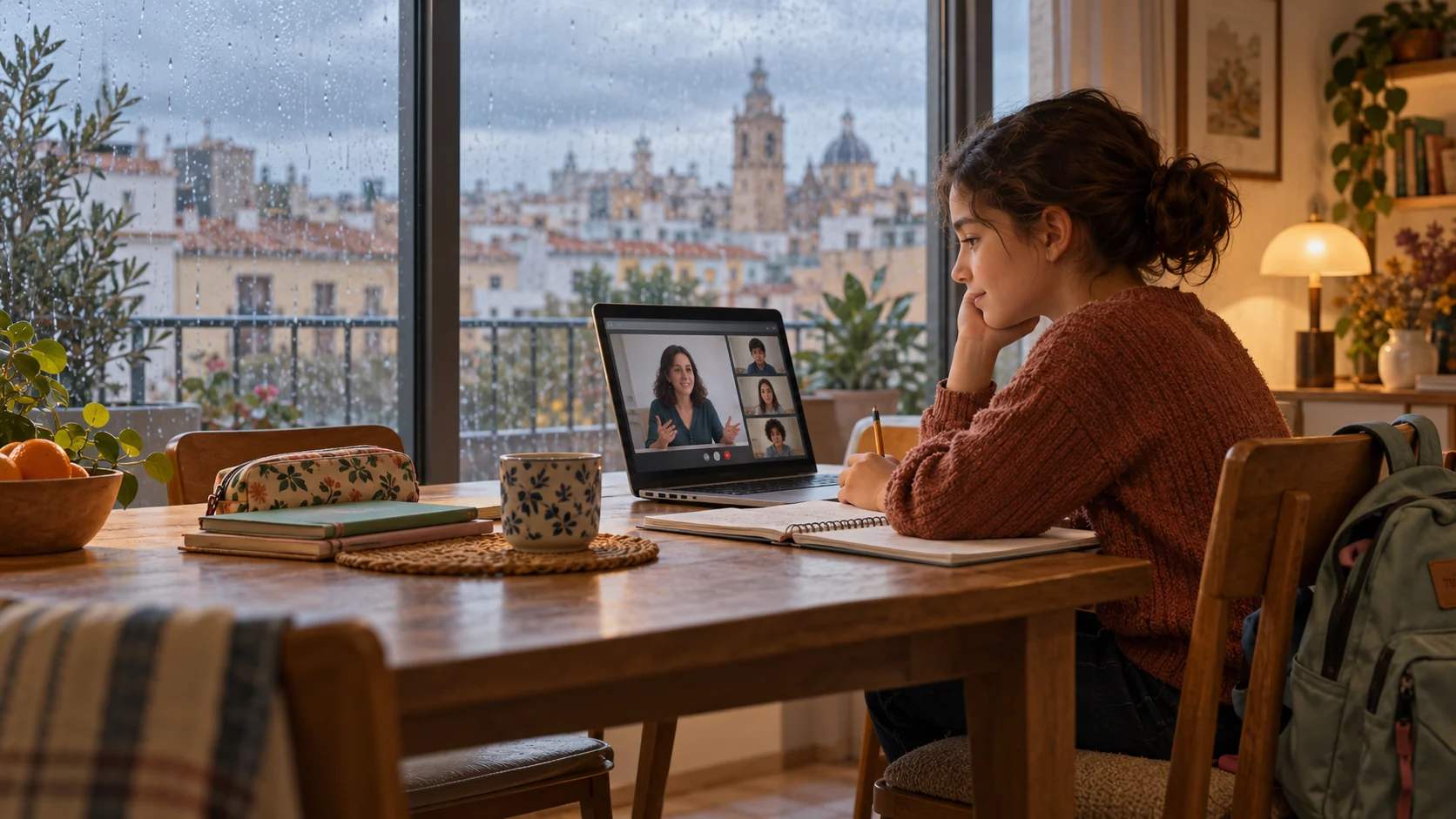
Keeping people away from dangerous journeys makes sense. The more difficult question comes afterwards: how much learning carries on when the classroom moves into the living room?
Online teaching deserves some credit here. A cancelled journey needn’t mean a completely lost lesson. Students can still hear an explanation, ask questions, practise a skill and receive feedback. A recording can give them another chance to understand something that went past too quickly the first time.
For some students, that extra control is useful. Pausing an explanation is considerably easier than asking a teacher to repeat the same sentence for the fourth time while everyone else starts packing up.
Research also gives us reasons to take remote learning seriously. The Education Endowment Foundation’s review found that teaching quality matters more than whether an explanation arrives live or through a recording. Clear explanations, suitable tasks and opportunities to interact remain important. A screen doesn’t automatically make a lesson ineffective. EEF’s evidence review
Still, being connected and making progress are two different things.
A student can appear on the attendance list without understanding much of what happened. In a classroom, a teacher might notice the unfinished first question, the puzzled expression or the sudden enthusiasm for sharpening a pencil. Online, those clues can be harder to spot.
Then there is the small matter of home.
One child has a laptop, a quiet room and someone nearby who can help. Another is sharing a device with a sibling while a parent tries to work at the same table. Both may be expected to complete the same lesson, but they are starting from rather different positions.
The EEF review identifies access to technology as an important condition for successful remote learning, particularly for disadvantaged pupils. And access means more than having something with an internet connection. Reading instructions, joining a call and writing an answer on a parent’s phone is quite a different experience from working at a computer. EEF’s findings on access
Age matters too. A reasonably independent teenager may manage a short spell of online lessons quite happily. A younger child may need help opening the activity, understanding the instructions and resisting the powerful educational possibilities of the swivel chair.
For parents, an online school day can therefore become an unexpected supervision shift. For teachers, it can mean adapting a lesson at short notice while handling their own family arrangements. Neither group necessarily has spare time waiting politely in the diary.
So should we worry about students falling behind?
We should pay attention, without treating every rain-alert day as a miniature lockdown. Research into education during the pandemic found learning deficits and unequal effects between students. But those findings concern a much longer, more complicated disruption. They cannot tell us how much progress a child in Valencia loses—or maintains—during an occasional day of weather-related online teaching. Review in Nature Human Behaviour
The concern is what happens if interruptions accumulate. Are students keeping up with new material? Are the same children repeatedly missing activities? Does the class need substantial reteaching when everyone returns?
Those questions are more useful than counting uploaded worksheets.
If online lessons are becoming a regular backup, they deserve a plan that works under ordinary household conditions. Schools could agree on a familiar place to find work, keep instructions straightforward and provide tasks that don’t require a child to remain on a video call all day. Short explanations, manageable practice and feedback may achieve more than an ambitious timetable that falls apart before breakfast.
There should also be room for flexibility. If a family is dealing with flooding, a power cut or genuine worry about their safety, submitting an exercise on time is unlikely to be the most pressing issue.
Once students return, a brief conversation or a few well-chosen questions can help teachers find out what actually stuck. Anyone who missed out needs a route back into the lesson, rather than a growing pile of overdue work.
Online teaching can help Valencia’s students keep learning through disruption. Whether it does so successfully depends on the lesson, the support available and what happens when they get back to class.
When the sun comes out again, it would be good to find that everyone can pick up where they left off. Including the child who spent Tuesday negotiating laptop access with a sibling.
The missing trainer will probably remain a separate investigation.